The Complete Implementation Path from Chip to System (Part 3)
This document aims to provide system engineers, hardware developers, and prgject decision-makers in the field of industrial automationwith a full-stack technology guide covering chip selection, hardware design. protocol stack development, and system integration.t helpslocal enterprises build independent and controllable HART technology capabilities.
1 Typical Application Scenarios
The versatility and maturity of HART technology have given it a wide range of applications in the field of industrial automation. The following are the three most representative application scenarios:
1.1 Process Control in the Process Industry
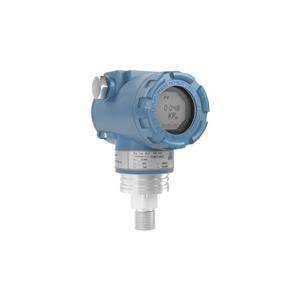
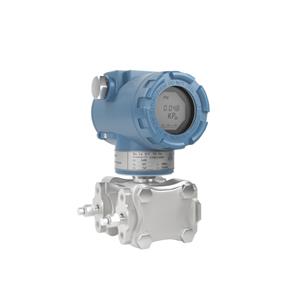
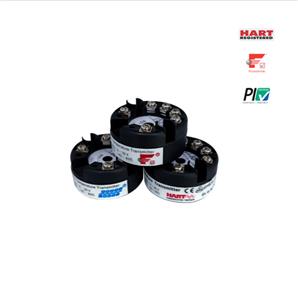
Process industries such as petrochemicals, power generation, and metallurgical manufacturing represent the most traditional and core application stronghold of HART technology. In a DCS (Distributed Control System) architecture, HART smart transmitters (for temperature, pressure, flow, and level) transmit process variables (PV) to the control system via 4-20 mA signals, while simultaneously providing auxiliary information such as device status, ambient temperature, and second/third process variables through the digital channel. Operators can remotely perform span adjustments, zero-point calibration, and loop testing from the control room using a HART communicator or host software, eliminating the need to enter hazardous field environments.
Typical Architecture: Field HART instrument → Safety barrier/Isolation barrier → DCS I/O module (HART channel) → Control network → Engineering station/Operator station. Major DCS vendors such as ABB, Siemens, Emerson, and Honeywell all provide native HART I/O module support.
1.2 Equipment Condition Monitoring and Predictive Maintenance
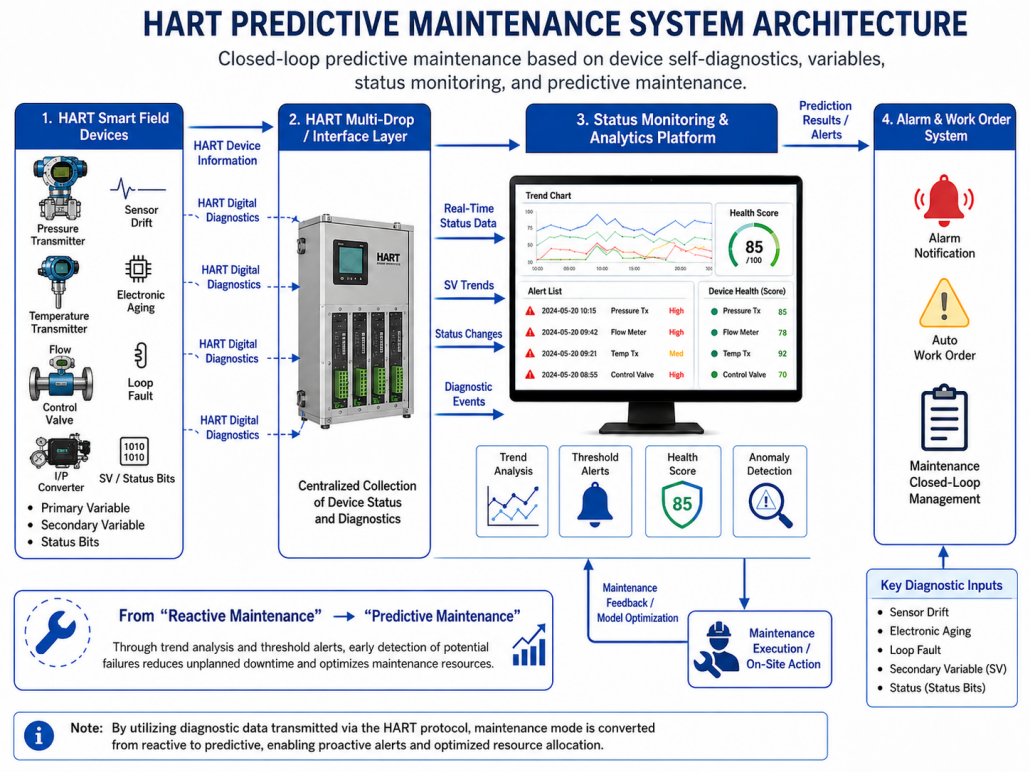
By leveraging equipment self-diagnostic information transmitted via the HART protocol (including sensor drift, electronic component aging, loop anomalies, etc.), combined with the data analysis capabilities of host software, enterprises can achieve a paradigm shift from "reactive maintenance" to "predictive maintenance." The secondary variables and status bits periodically reported by HART devices provide real-time data inputs for maintenance decision-making systems. Through trend analysis and threshold-based alerts, potential equipment faults can be detected early, minimizing unplanned downtime losses.
1.3 Smart Instruments and Distributed Sensor Networks
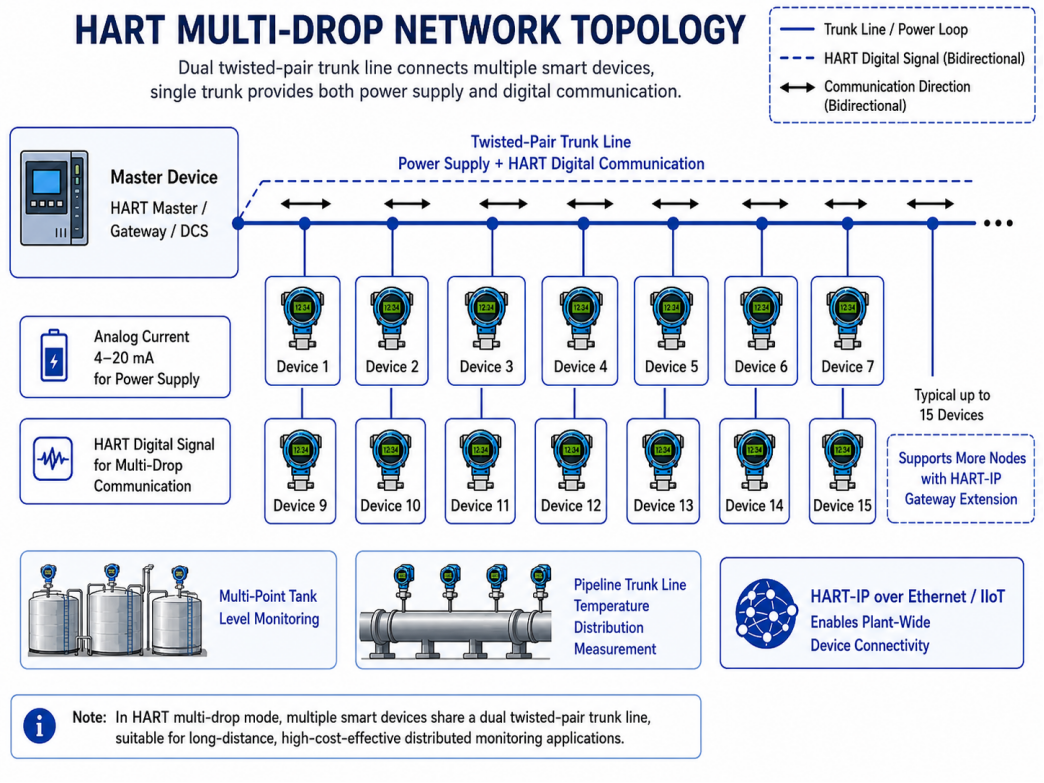
In HART multi-drop mode, a single twisted-pair bus can connect up to 15 smart devices in parallel (modern extended protocols support even more nodes), forming a distributed sensor network with both power and communication provided over a single bus. This architecture is particularly suitable for applications with space constraints and high cabling costs, such as multi-point level monitoring in tank farms and temperature distribution measurement along pipelines. The introduction of the HART-IP protocol further enables seamless integration of HART devices into Ethernet and Industrial Internet of Things (IIoT) architectures, facilitating device interconnection across plant sites and geographical regions.
2 Competitive Alternative and Industry Outlook
Against the dual backdrop of profound adjustments in the global supply chain landscape and the accelerated advancement of industrial self-sufficiency strategies, highly competitive alternative solutions for HART controller and protocols have become an important topic in the field of industrial automation. Encouragingly, manufacturers represented by Microcyber have achieved comprehensive breakthroughs in core areas such as HART controller, protocol stack software, and testing and certification tools, providing mature alternative options with compatibility and cost advantages.
2.1 Performance Benchmarking
Two core controller from Microcyber—the HT5700 and HT1200M—have achieved mass production and large-scale application, having passed rigorous industrial field validation.
HT5700 vs. AD5700: It features a fully compatible register architecture and pin definition, supporting pin-to-pin direct replacement, allowing customers to complete domestic substitution without modifying PCB designs. Communication performance metrics (FSK frequency deviation, modulation depth, receive sensitivity) all meet the requirements of the HART physical layer specification, with an operating temperature range of -40°C to +125°C. The unit price for bulk purchases is reduced by more than 50% compared to imported solutions, and the lead time for large orders has been shortened from 12–16 weeks (for imported solutions) to 4–6 weeks.
HT1200M vs. A5191HRT: It features a fully compatible register architecture and pin definition, supporting pin-to-pin direct replacement, allowing customers to complete domestic substitution without modifying PCB designs. Communication performance metrics (FSK frequency deviation, modulation depth, receive sensitivity) all meet the requirements of the HART physical layer specification, with an operating temperature range of -40°C to +85°C for industrial wide-temperature applications. The unit price for bulk purchases is reduced by more than 50% compared to imported solutions, and the lead time for large orders has been shortened from 12–16 weeks (for imported solutions) to 4–6 weeks.
2.2 Secure and Autonomous Supply Chains
The value of choosing a competitive HART alternative solution goes far beyond cost optimization. In the current environment of high uncertainty in the global semiconductor supply chain, such alternative solutions provide three layers of strategic assurance: supply continuity assurance (free from the impact of export controls in specific regions), technical support response assurance (localized FAE teams with 48-hour on-site response), and technology evolution collaboration assurance (functional customization and protocol extension based on customer requirements). For critical infrastructure sectors such as energy, chemicals, and water conservancy, a HART solution with supply chain resilience holds irreplaceable strategic significance.
2.3 Technology Evolution Trends and Foresight
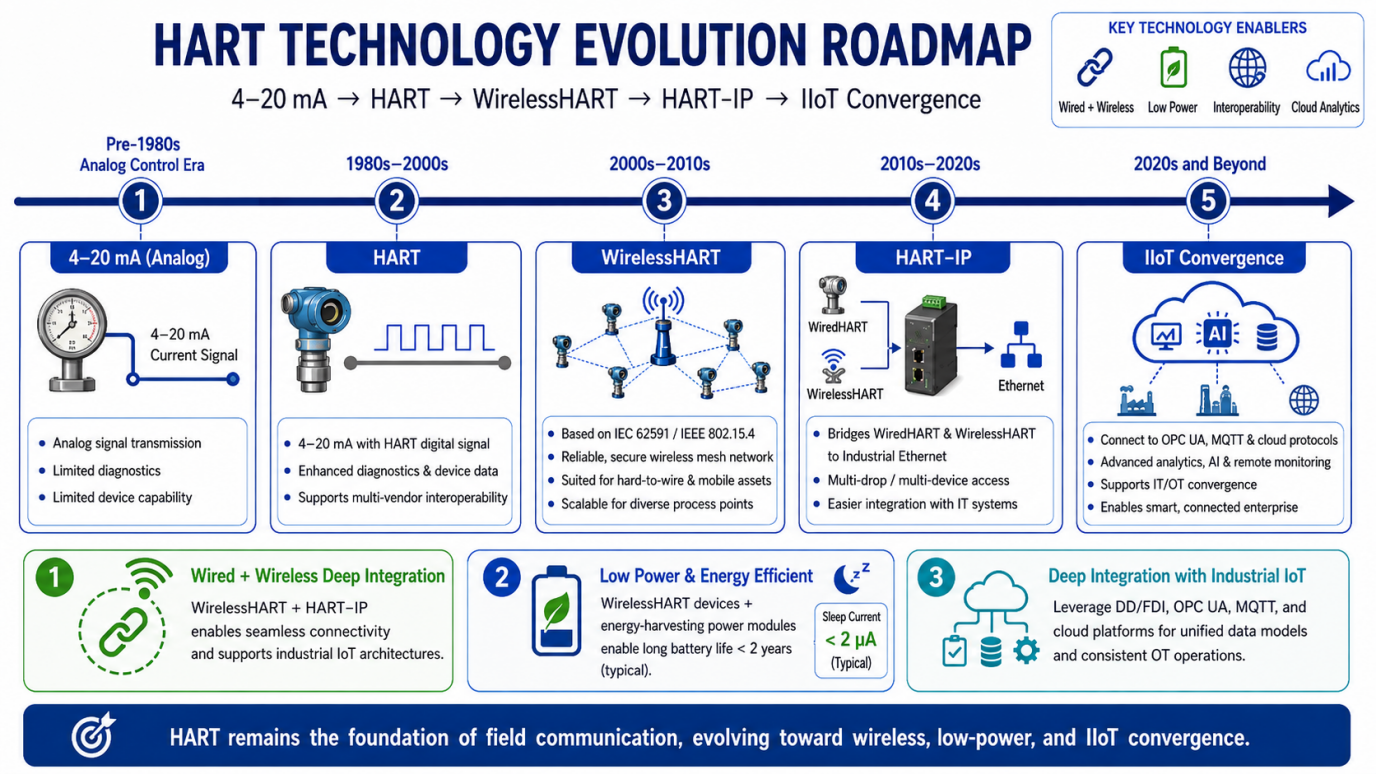
Looking ahead, HART technology is continuously evolving in the following three directions, injecting new vitality into the field of industrial automation:
Deep integration of wired and wireless technologies: WirelessHART (IEC 62591) is based on the IEEE 802.15.4 wireless standard, inherits the command structure and application layer ecosystem of the HART protocol, while eliminating wiring constraints. The HART-IP protocol further enables seamless bridging between wired HART, WirelessHART, and Ethernet, providing a unified device access layer for the Industrial Internet of Things (IIoT).
Low Power Consumption and Energy Autonomy: With the maturation of energy harvesting technologies (thermoelectric, vibration, RF energy), next-generation HART devices are evolving toward "battery-free" or "ultra-long battery life" directions. The combination of low-power HART controller (e.g., AD5700 with sleep current < 2 μA) and energy-optimized protocol stacks enables field devices to achieve long-term autonomous operation relying on energy harvesting.
Deep Integration into the Industrial Internet of Things (IIoT): HART devices connect to industrial internet protocols such as OPC UA and MQTT via HART-IP gateways or WirelessHART gateways, becoming the data source for digital twins, AI analytics, and cloud-based operations and maintenance. The unification of HART Device Descriptions (DD) and the FDI (Field Device Integration) standard ensures consistency and interoperability of device information models across different platforms.
Conclusion
With its unique "analog + digital" dual-mode architecture, four decades of industrial field validation, a global installed base of over 40 million devices, and a complete ecosystem ranging from controllers to systems, the HART protocol is undoubtedly one of the most mature and reliable field communication technologies in the field of industrial automation. In the historical process of industrial digital transformation, HART technology provides not only a communication protocol itself, but also a gradual upgrade path that balances economy and advancement—allowing enterprises to protect existing investments while steadily moving toward a new era of digitalization and intelligence.
Looking to the future, with the widespread adoption of WirelessHART, the broad application of HART-IP, and deep integration with industrial IoT platforms, HART technology will continue to gain new vitality. For every engineer and decision-maker in the field of industrial automation, a deep mastery of HART technology—from chip selection to system integration—serves not only as the technical foundation for the success of current projects but also as a core competitive competency for the future era of industrial intelligence.