Complete Guide to Temperature Transmitters(HART Temperature Transmitter): Principles, Types, Applications, and Selection Guide
In industrial automation control systems, the temperature transmitter is a critical device that converts temperature signals detected by sensors into standardized electrical signals, enabling precise temperature measurement and remote transmission.
Definition and Function of HART Temperature Transmitters
A temperature transmitter is an instrument that converts temperature variables into standardized output signals suitable for transmission. Its primary function is to process and convert temperature signals from various sensors (such as thermocouples or RTDs), outputting uniform standard signals like 4-20mA current or 0-5V voltage signals. This enables seamless connection and communication with other automation equipment (e.g., PLCs, DCS systems).
For example, in a chemical production process, a temperature transmitter converts the temperature signal from a thermocouple inside a reactor vessel into a standard current signal, which is then transmitted to the control system to achieve precise control of the reaction temperature.
Working Principle of HART Temperature Transmitters
The working principle of a temperature transmitter typically involves the following steps:
1. Temperature Sensor Detection: Temperature sensors such as thermocouples or RTDs generate corresponding resistance values or thermoelectric potentials based on temperature changes.
2. Signal Input: The transmitter receives the resistance value or thermoelectric potential signal from the temperature sensor.
3. Signal Processing: Internal circuitry amplifies, filters, and linearizes the input signal to eliminate interference and enhance signal quality.
4. Signal conversion: The processed signal is converted into a standard electrical signal, such as 4–20mA or 0–5V.
5. Output signal: The standard electrical signal is transmitted through the output port to subsequent control equipment or display instruments.
Types of HART Temperature Transmitters
1. Thermocouple temperature transmitter: Specifically designed to convert the thermoelectric potential generated by thermocouples into standard electrical signals, suitable for high-temperature measurement applications.
2. RTD Temperature Transmitter: Processes resistance value changes from RTD sensors, commonly used in medium-to-low temperature applications.
3. Integrated Temperature Transmitter: Combines the temperature sensor and transmitter into a compact package, reducing installation and wiring complexity.
Features and Advantages of HART Temperature Transmitters
1. Enhanced Measurement Accuracy: Precise processing and conversion of temperature signals minimize measurement errors, improving temperature measurement precision.
2. Enhanced Signal Stability: Outputs standardized signals with superior stability and interference resistance, ensuring reliable transmission in demanding industrial environments.
3. Facilitates Remote Monitoring and Control: Standardized signals enable long-distance transmission, simplifying remote monitoring and control for large-scale industrial production sites.
4. High Compatibility: Compatible with diverse temperature sensor types and automation control systems, offering broad applicability.
Installation and Usage of HART Temperature Transmitters
1. Installation Location Selection: Install near the temperature sensor to minimize signal attenuation from excessively long transmission lines. Choose locations with relatively stable ambient temperatures, free from strong vibrations and electromagnetic interference.
2. Wiring Precautions: Connect power, input, and output lines correctly according to the transmitter's wiring diagram, ensuring all connections are secure and reliable.
3. Commissioning and Calibration: Prior to operation, commission and calibrate the temperature transmitter to ensure accurate signal output.
As a vital component in temperature measurement and control systems, temperature transmitters play a pivotal role in industrial production and automation. With ongoing technological advancements and innovations, their performance will continue to improve, providing robust support for achieving more precise and efficient temperature measurement and control.
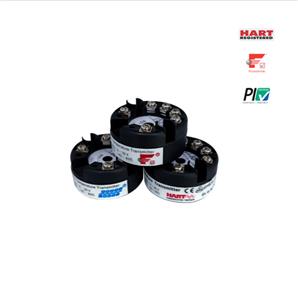
The NCS-TT306 series HART intelligent temperature transmitter is a dual-channel temperature transmitter module with high reliability, high long-term stability, high measurement accuracy, and low temperature drift. It supports 4~20mA+HART protocol (supports BURST function), LCD display, and dual-channel redundancy function.It has been certified by multiple international certifications such as explosion-proof, CE, EMC, SIL2, etc.It can be widely used in petroleum, chemical, electric power,metallurgy and other industries.
NCS-TT306 Series HART Temperature Transmitter:
1. Certified by CE, Ex ia, EMC, SIL2 and HART
2. Dual channel, supporting multiple thermistor and thermocouple sensors, and supporting redundant hot backup of sensors
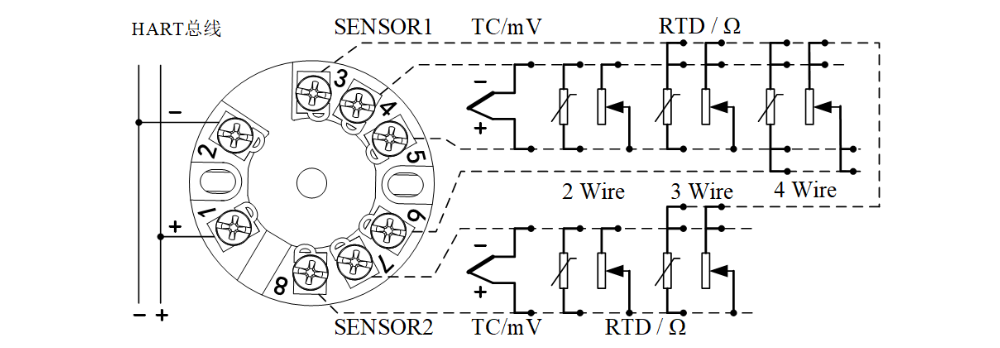
3. Supports 2/3/4-wire when connecting thermal resistors
4. The cold end compensation accuracy of the thermocouple can reach ± 0.15 ℃ (externally connected Pt100)
5. High precision (Pt100: ± 0.1 ℃), low-temperature drift (Pt100: ± 0.003 ℃/℃)
6. EDD/SSD/FDI/DTM are provided, which are compatible with various DCS systems
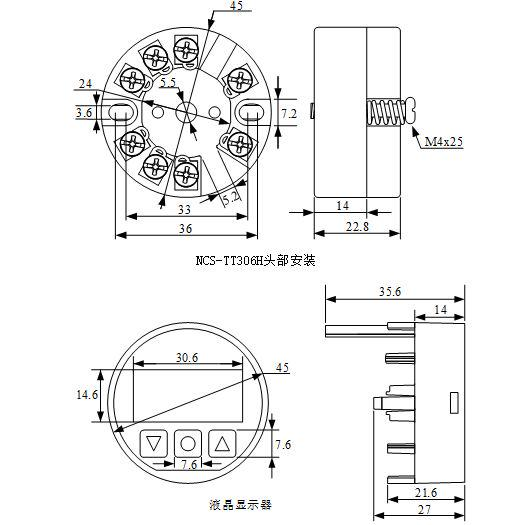
NCS-TT306 Series HART Temperature Transmitter size shown:
NCS-TT306 Series HART Temperature Transmitter wiring shown:
NCS-TT306H adopts digital technology and can be applied to a variety of thermal resistance and thermocouple sensors. It has a wide range and a simple interface between the field and the control room, and can greatly reduce installation, operation and maintenance costs.
NCS-TT306H series temperature transmitter supports 4-20mA+HART protocol and LCD display, and can be widely used in petroleum, chemical, electric power, metallurgy and other industries.
NCS-TT306 Series HART Temperature Transmitter technical indicators of thermal power resistance:
RTD Accuracy (25℃)
| Signal type | Sensor measuring range (℃) | Accuracy (25℃) | Temperature drift (/℃) |
| resista nce signal | 0~500Ω | ±0.04Ω | ±0.001Ω |
0~2000Ω | ±0.35Ω | ±0.015Ω | |
0~4000 | ±0.35Ω | ±0.015Ω | |
0~8000Ω | ±0.7Ω | ±0.03Ω | |
| Cu50 | -50 ~ 150 ℃ | ±0.10℃ | ±0.005℃ |
Cu50_GOST | -180 ~ 200 ℃ | ±0.10℃ | ±0.005℃ |
Cu100 | -50 ~ 150 ℃ | ±0.10℃ | ±0.003℃ |
Cu100_GOST | -180 ~ 200 ℃ | ±0.10℃ | ±0.003℃ |
| Pt50_GOST | -200 ~ 850℃ | ±0.10℃ | ±0.005℃ |
Pt100 | -200 ~ 850℃ | ±0.10℃ | ±0.003℃ |
Pt100_GOST | -200 ~ 850℃ | ±0.10℃ | ±0.003℃ |
Pt200 | -200 ~ 850℃ | ±0.10℃ | ±0.005℃ |
Pt500 | -200 ~ 850℃ | ±0.10℃ | ±0.005℃ |
Pt1000 | -200 ~ 850℃ | ±0.10℃ | ±0.005℃ |
Ni50 | -60 ~ 180℃ | ±0.10℃ | ±0.004℃ |
Ni100 | -60 ~ 180℃ | ±0.10℃ | ±0.002℃ |
Ni120 | -60 ~ 180℃ | ±0.10℃ | ±0.002℃ |
Ni1000 | -60 ~ 180℃ | ±0.10℃ | ±0.002℃ |
NCS-TT306 Series HART Temperature Transmitter thermocouple technical indicators
Thermal Couple Accuracy (25℃)
Signal type | Sensor measuring range (℃) | Accuracy (25℃) | Temperature drift (/℃) |
millivolt | -100 ~ +100mV | ±0.025m | ±0.0015 mV |
| B | 500 ~ 1810 | ±0.77℃ | ±0.050℃ |
E | -200 ~ 1000℃ | ±0.20℃ | ±0.025℃ |
J | -190 ~ 1200℃ | ±0.35℃ | ±0.01℃ |
K | -200 ~ 1372℃ | ±0.40℃ | ±0.025℃ |
N | -190 ~ 1300℃ | ±0.50℃ | ±0.015℃ |
R | 0 ~ 1768℃ | ±0.75℃ | ±0.023℃ |
S | 0 ~ 1768℃ | ±0.70℃ | ±0.023℃ |
T | -200 ~ 400℃ | ±0.35℃ | ±0.015℃ |
L_GOST | -200 ~ 800℃ | ±0.50℃ | ±0.0375℃ |
A(W5ReW20Re) | 0 ~ 800℃ | ±1.45℃ | ±0.06℃ |
C(W5ReW26Re) | 0 ~ 800℃ | ±1.15℃ | ±0.09℃ |
D(W3ReW25Re) | 0 ~ 800℃ | ±1.55℃ | ±0.07℃ |
NiCrAuFe | -273 ~ 7℃ | ±0.65℃ | ±0.020℃ |
| CuAuFe | -270 ~ -196℃ | ±0.85℃ | ±0.035℃ |
NCS-TT306 Series HART Temperature Transmitter basic parameter:
| Bus Interface | 4~20mA (supports current reversal) + HART 7 (supports BURST mode) |
Bus Power | 11.0 ~ 45 VDC |
Wiring Method | 2, 3, 4 wire |
Input Signal | Resistance signal: 0~500Ω、0~2000Ω、0~4000Ω Thermal resistance sensor: Cu50、Cu50_GOST、Cu100、Cu100_GOST、 Pt50_GOST、Pt100、Pt100_GOST、Pt200、Pt500、Pt1000、Ni50、Ni Ni120、Ni1000 mVsignal: -100mV~100mV; Thermocouple sensor: B、E、J、K、N、R、S、T、L_GOST、 A(W5ReW20Re)、C(W5ReW26Re)、D(W3ReW25Re)、 NiCrAuFe、CuAuFe; |
Protocol Version | HART 7 |
Number of Channels | dual channel |
Input Impedance | ≧10MΩ |
Electrical Isolation | 2kVAC/50VAC |
Voltage Effect | ±0.005%/V |
| LCD Display | Head mounted: supports LCD display or no display (optional) Rail installation: no display |
Key Operation | Support button setting parameters |
Working Temperature | -40(-55)℃~85℃ (with display) -20 ~ 70℃ (no display) |
Humidity Range | (5~95)%RH |
Storage Temperature | -40 ~ 85℃ |
Start Time | ≤10 seconds |
Update Time | 0.8 ~ 1.3s |
Damping Adjustment | Time constant 0~32 seconds |
Alarm Signal | Saturation current lower limit: [3.75-4.0)mA, default value 3.8mA Upper limit of saturation current: (20-20.8]mA, default value 20.5mA Alarm current lower limit: [3.5-3.7]mA, default value 3.6mA Upper limit of alarm current: [21.0-23.0]mA, default value 21.75mA |
Current Accuracy | 0.05% |
Voltage Effect | ±0.005%/V |
Terminal Torque | 0.4Nm |
Wire Specifications | 1.5mm2 |
Anti-vibration Specifications | 2-25Hz:±1.6mm;25-100Hz:±4g |
Protection Level | Terminal IP00, module housing IP20, rail housing IP20 |
Weight | Module ≦ 75g; graphics card: ≦50g; guide rail ≦ 100g |
The NCS-TT105 Temperature Transmitter is a new-generation smart field device built on fieldbus technology. Designed for precision temperature measurement and reliable process control, it supports HART, Foundation Fieldbus (FF), and PROFIBUS PA protocols, making it suitable for petroleum, chemical, electric power, metallurgy, and other industrial applications.The transmitter offers dual-channel input, advanced digital processing, excellent temperature drift performance, and wide sensor compatibility including RTDs and thermocouples.It is an essential temperature measurement device for modern industrial automation.
Key Features of the NCS-TT105 Temperature Transmitter:
1. Multi-protocol compatibility Supports FF H1, PROFIBUS PA, and HART (latest versions)
2. Dual-channel sensor input Supports redundancy Hot-backup capabilities for critical processes
3. Wide RTD support 2-wire, 3-wire, and 4-wire input modes
4. High accuracy and stability
Cold-junction compensation accuracy: ±1.0°C
High precision: better than 0.1 grade
Low temperature drift: better than ±50 ppm/°C
Enhanced version: ±0.1°C for Pt100 / Pt1000
5. Flexible thermocouple compatibility Supports B, E, J, K, N, R, S, T thermocouples ±0.025 mV accuracy for millivolt measurement