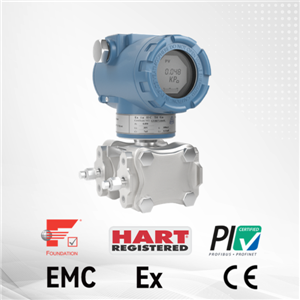
Multi-channel Temperature Transmitter Enabling Efficient On-site Monitoring
1、Overview
In process industries such as petrochemicals, metallurgy, power, and building materials, complex operating conditions are common---including dense temperature monitoring points, high temperatures and dust levels, strong vibration, and severe electromagnetic interference. Many areas are also hazardous environments that are prone to flammability and explosion. Traditional single-channel temperature monitoring solutions suffer from a range of problems, such as excessive wiring, numerous supporting devices, low measurement accuracy, weak anti-interference capability, high operation and maintenance costs, and poor integration with digital systems.
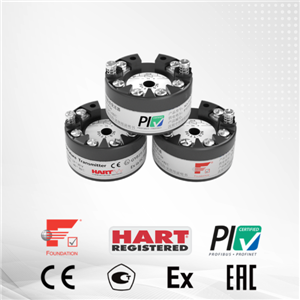
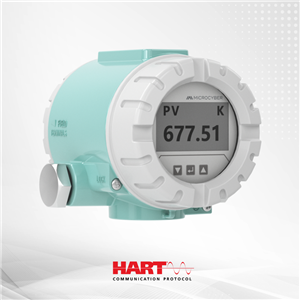
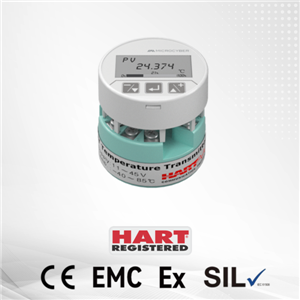
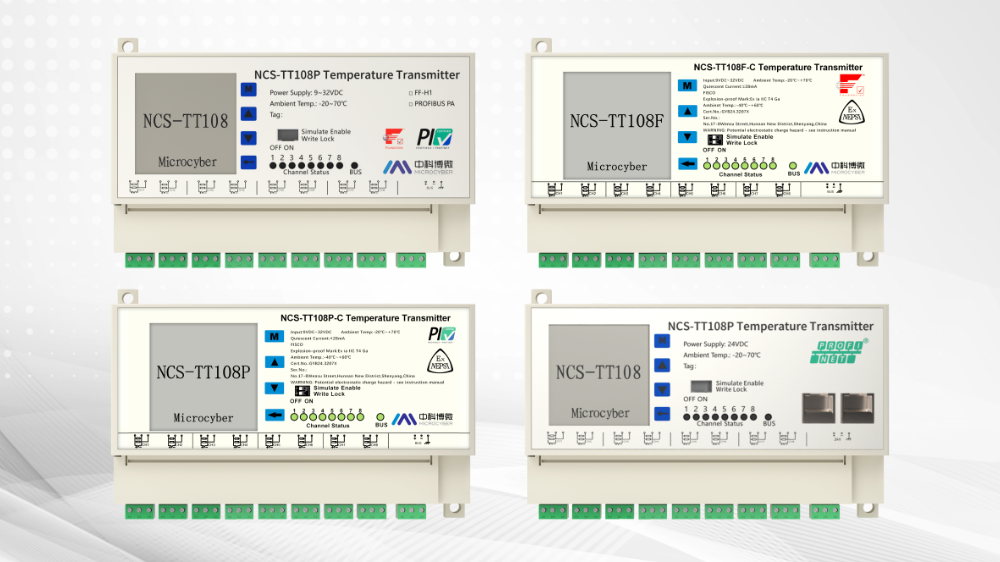
To address pain points in the industry, Microcyber's NCS-TT108 series eight-channel intelligent temperature transmitter creates an integrated, high-precision, highly safe, and easy-to-maintain digital multi-point temperature monitoring system. This product strictly complies with the GB/T 18268-2010 electromagnetic compatibility standard, complies with international fieldbus specifications, and possesses intrinsically safe explosion-proof certification. Its FF and PROFIBUS PA protocols have received internationally recognized certifications, making it safe for use in explosion-proof hazardous areas such as petrochemical and chemical plants. The device also supports customized explosion-proof enclosures, making it fully adaptable to a wide range of harsh industrial environments.
The equipment is compatible with multiple temperature signal acquisition methods, including RTDs, thermocouples, and millivolt voltage sensors. It integrates core functions such as signal calibration, thermocouple cold junction compensation, and channel fault self-testing. Equipped with mainstream industrial bus protocols such as FF, PROFIBUS PA, PROFINET, and MODBUS-RTU, it can seamlessly connect to PLCs and DCS automation control systems from all major brands. The product adopts an integrated architecture for centralized data acquisition, bus transmission, and remote control — significantly simplifying field equipment and wiring while improving measurement accuracy and system stability. It supports both local calibration and remote configuration for flexible operation and maintenance. This comprehensive approach meets the high-precision, high-reliability, low-cost, and high-safety temperature monitoring needs of industrial sites, providing a solid foundation for safe production, equipment maintenance, and digital factory upgrades.
2、Industry Pain Points and Core Requirements
1) Pain Points of Traditional Solutions
In industries such as petrochemicals, metallurgy, and power, the number of temperature measurement points for core equipment such as reactors, towers, and large units is enormous. Continuing to use traditional single-channel temperature transmitters will bring multiple problems:
● Complex installation and high investment : The large number of measurement points requires extensive cabling and a complicated installation process.Additionally, significant auxiliary equipment — such as safety barriers and junction boxes — is required, resulting in high hardware and installation costs.
● High maintenance difficulty : Instruments are distributed across the site, making routine inspections, calibration, and fault diagnosis inefficient. This leads to rising labor and maintenance costs.
● Poor digital compatibility : Limited communication capabilities make it difficult to integrate with modern industrial bus architectures, hindering the development of digital and intelligent systems in factories.
2) Core On-site Requirements
Based on actual industrial site conditions, temperature measuring equipment must meet the following five core requirements:
● Integrated design : A single device should acquire multiple signals, simplifying equipment layout and wiring while effectively controlling overall costs.
● High precision and high stability : The device should feature thermocouple cold junction compensation and strong electromagnetic interference resistance, making it suitable for complex operating conditions and ensuring accurate and stable temperature data.
● Convenient operation and maintenance : Support for on-site debugging and remote online configuration helps quickly locate and resolve equipment faults, reducing maintenance complexity.
● Strong compatibility : The device should support mainstream industrial bus protocols, enabling direct connection to various automation systems without additional protocol converters.
● All-scenario protection :The equipment should have industrial protection capabilities, including explosion-proof, waterproof, and dustproof ratings, enabling stable long-term operation in outdoor and hazardous areas.
3 Core Solution Architecture
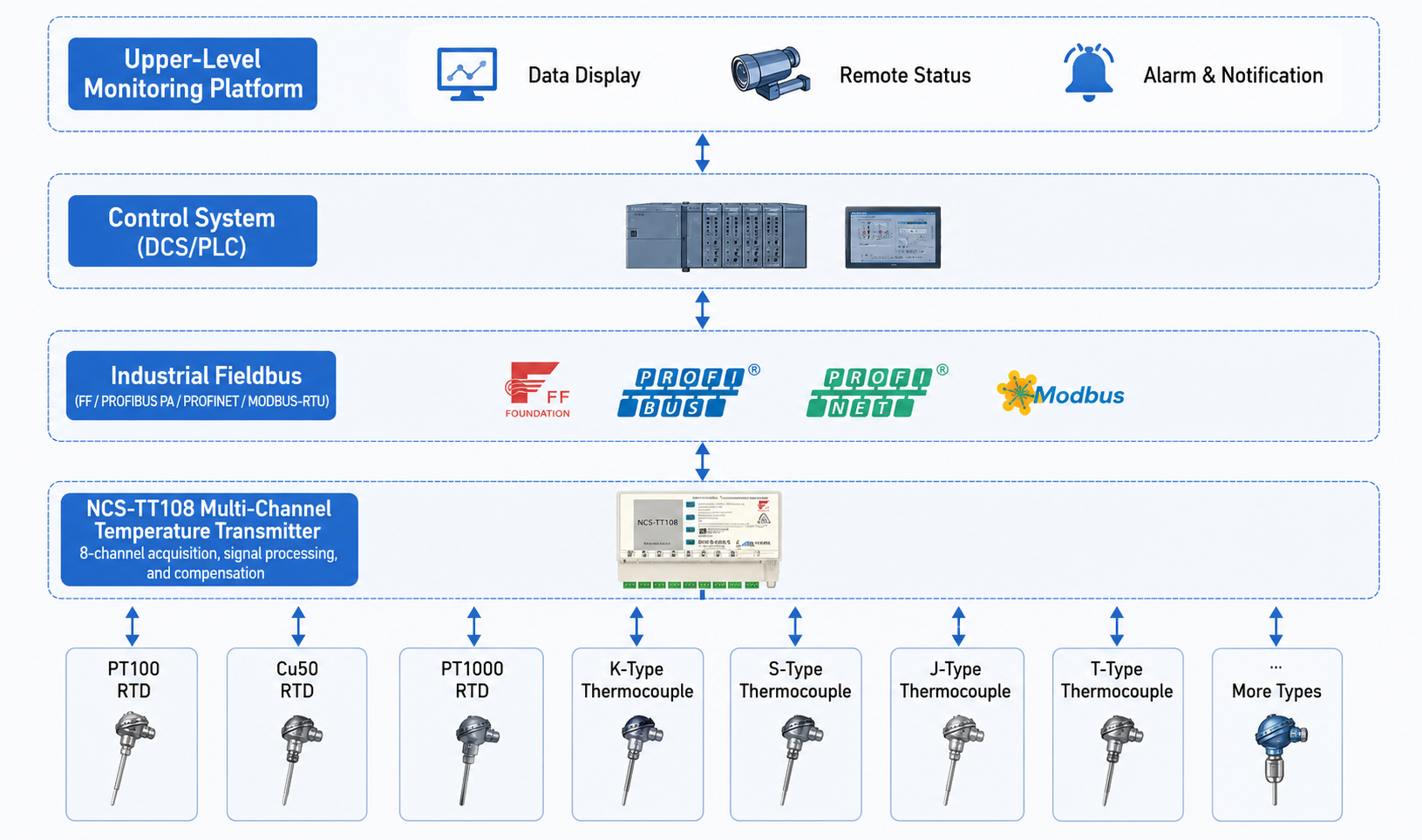
The NCS-TT108 multi-channel temperature transmitter adopts an integrated architecture of centralized data acquisition, bus transmission, and remote control to build a complete closed-loop temperature measurement system. The overall operation process is as follows:
● Multi-channel centralized acquisition : A single device can connect to up to eight channels of RTD, thermocouple, and millivolt sensors simultaneously, unifying the acquisition of multiple temperature signals.
● Front-end signal processing : The device independently performs signal conversion, thermocouple cold junction compensation, linear calibration, and data processing, ensuring data quality from the source.
● Digital bus transmission : Processed temperature data and equipment status are reliably uploaded to DCS and PLC control systems via industrial buses such as FF, PROFIBUS PA, PROFINET, and MODBUS-RTU.
● Dual operation and maintenance management : The device features an LCD screen and physical buttons for on-site calibration. When paired with dedicated host configuration software, it also enables remote parameter configuration, fault diagnosis, and alarm notifications, forming a complete temperature measurement loop from data acquisition and signal transmission to remote monitoring and two-way maintenance .
4 Solution Core Advantages
1) Compact Design Reduces Total Lifecycle Cost
● Streamlined hardware : One device replaces eight traditional single-channel transmitters, significantly reducing the need for auxiliary materials such as safety barriers and junction boxes.
● Simplified cabling : Eight signals are transmitted over a single bus, drastically reducing cable and cable tray usage and cutting installation costs by over 30%.
● Optimized maintenance : Centralized deployment makes inspection, calibration, and troubleshooting more efficient, reducing operation and maintenance expenses.
2) Multi-protocol Compatibility, Flexible and Efficient System Integration
● Coverage of all mainstream protocols : Supports multiple industrial standard protocols and can be directly connected to mainstream domestic and international DCS and PLC systems such as Siemens, Yokogawa, and Honeywell without the need for additional protocol converters.
● Standardized and rapid integration : Comes with complete device description files to meet system configuration and data interaction standards.
3) Precise Measurement, High Stability, Adaptable to Complex Working Conditions
● High-accuracy temperature measurement : Accuracy exceeds Class 0.1, with a temperature drift as low as ±50 ppm/°C, ensuring long-term data accuracy.
● Professional compensation technology : Built-in high-accuracy thermocouple cold junction compensation module with a compensation accuracy of ±1.0°C, effectively eliminating ambient temperature interference.
● Flexible wiring options : Supports both two-wire and three-wire RTD connections, adapting to various field sensor types.
4) Industrial-grade Protection, Safe and Reliable, Suitable for Harsh Environments
● Authoritative explosion-proof certification : Holds intrinsically safe explosion-proof certification; FF and PROFIBUS PA protocols have received international approval, making the device safe for use in hazardous areas such as petrochemical and chemical plants.
● Customized protection solutions : Explosion-proof enclosures can be customized according to on-site needs to meet the industrial protection requirements of various scenarios.
● Strong anti-interference capability : Designed in accordance with GB/T 18268-2010 electromagnetic compatibility standards to withstand on-site electromagnetic interference.
5 Expected Results and Value Analysis / Application Case Analysis
1) Core Technology Performance Optimization and Improvement (quantitative indicators)
Compared to traditional single-channel temperature measuring instruments, this product offers a comprehensive performance improvement:
● Temperature measurement accuracy : The measurement accuracy is better than 0.1 grade, with low temperature drift design (±50ppm/℃) ; thermocouple cold junction compensation accuracy is ±1 ℃ , effectively solving the problems of data drift and temperature measurement deviation.
● Response speed: Data update cycle of 0.2 to 0.8 seconds, quickly capturing process temperature changes and meeting the requirements for precise temperature control.
● Operational stability : Designed to high electromagnetic compatibility standards, capable of continuous 24/7 stable operation.
● Fault maintenance : Combining local status indication and remote diagnostic functions, fault diagnosis is shortened from hours to minutes, and the channel fault identification accuracy rate is 100%.
2) Economic and Management Benefits
● Hardware cost : One unit can replace eight traditional transmitters, significantly reducing the investment in supporting auxiliary materials .
● Construction costs : The integrated structure simplifies wiring, effectively shortens the project duration, and saves labor costs .
● Production benefits : Precise temperature measurement and fault early warning reduce unplanned downtime caused by instrument malfunctions, ensure continuous and stable production, and improve the overall utilization rate of equipment.
● Digital value : Digital bus transmission connects field devices and the central control system, and remote operation and maintenance functions help factories transform towards automation and intelligence.
6、Typical application scenarios
The NCS-TT108 series transmitters have been successfully applied in various industries such as chemical, thermal power, and building materials, demonstrating stable operation and possessing high promotional value.
Case Study: A Cement Plant Production Line Project (PROFINET)
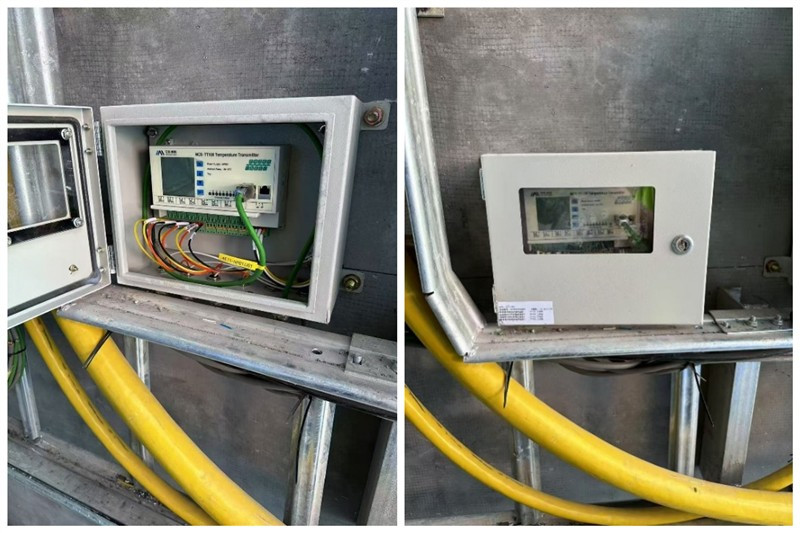
The project utilizes PROFINET protocol-compliant NCS-TT108PN transmitters in batches to conduct multi-point temperature monitoring of cement calcining equipment. The equipment is perfectly adapted to the harsh working conditions of high dust, strong vibration, and high temperature on site, and has been operating continuously without failure for over 3 years. At the same time, it can seamlessly connect to the existing PLC Ethernet control system, significantly improving temperature measurement accuracy and the level of intelligent management and control of the plant area.