Modbus to HART Gateway: The Ultimate Guide to Making Old Instruments "Smart" and Enabling Seamless Heterogeneous Network Integration
Have you ever encountered these headaches at industrial automation sites?
· Protocol Incompatibility: A large number of Modbus instruments on site cannot be directly connected to mainstream HART/DCS systems, making data retrieval difficult.
· Missing Information: Only a single 4-20mA current value can be read, while valuable temperature, pressure, and diagnostic information remains "locked" within the device.
· Costly Retrofits: To be compatible with new systems, old equipment often has to be scrapped, resulting in high costs and lengthy project timelines.
Don't let heterogeneous networks become a stumbling block in your digital transformation journey!
Today, we will introduce the "universal translator" of the industrial site —— the G0310Modbus to HART Gateway. It not only enables seamless protocol conversion but also revitalizes your existing assets!
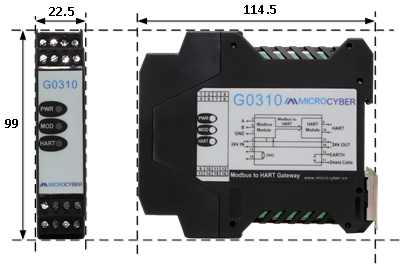
Why Choose the G0310Modbus to HART Gateway? Here are Its Core Advantages
1. Comprehensive Protocol Coverage
· Modbus Side (Master): Actively polls RS485 devices, supports function codes 01/02/03/04/05/06/16, and is compatible with the vast majority of Modbus instruments on the market.
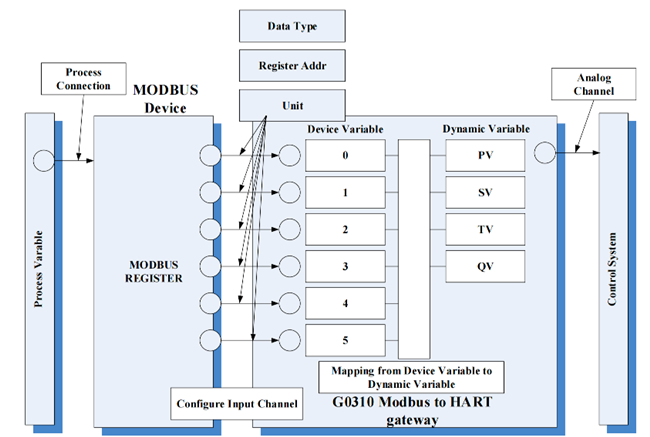
· HART Side (Slave): Fully complies with the HART 7.9 standard, supports mapping for 6 device variables, and easily outputs the four multivariable values: PV/SV/TV/QV.
· Dual Output (Analog + Digital): Retains the traditional 4-20mA analog signal while superimposing HART digital communication, ensuring perfect compatibility with both old and new systems.
2. Flexible Topology for Various Complex Scenarios
· Point-to-Point Mode: Set the address to 0 for mixed analog and digital communication, allowing direct connection to AI modules or handheld communicators.
· Multi-Drop Bus Mode: Use addresses 1-15 for pure digital communication, connecting multiple devices via the HART bus for cleaner wiring.
3.Rugged Quality for Harsh Environments
· Wide Power Supply Range: 12-42VDC, providing stable operation even during power fluctuations.
· Electrical Isolation: 500VAC strong isolation for maximum anti-interference capability.
· Wide Operating Temperature: -40℃ to 85℃, stable and reliable whether in extreme cold outdoors or high-temperature workshops.
· Compact Design: Standard DIN rail mounting saves space in the control cabinet.
Essential Tips for Engineers: 3 Steps to Seamless Integration
Many users worry about complicated configurations? Actually, getting started with the G0310 is very simple! Master the following techniques to increase your debugging efficiency by 50%:

✅ Technique 1: Wiring Considerations
· Loop Resistance is Key: HART communication requires a loop resistance between 230Ω and 800Ω.
Tip: If the on-site resistance is insufficient, simply connect a 250Ω resistor in series to solve the problem. If the resistance is too high, check for excessively long lines or poor contact.
· Anti-interference Wiring: For RS485, be sure to use shielded twisted-pair cable, connecting A+ to A+, B- to B-. Keep the cable away from strong interference sources like variable frequency drives.
✅ Technique 2: Mapping Configuration "Pairing"
· Match Data Types Correctly: Modbus register addresses are mapped to device variables (0-5) and then assigned to dynamic variables (PV/SV/TV/QV). Pay attention to data types such as 16-bit integers, 32-bit integers, and floating-point numbers. The byte order (Big Endian/Little Endian) must be consistent with the source device; otherwise, the readings might become garbled.
· Handy Verification Tip: First, use a Modbus master to read a known value. After mapping it through the G0310, compare the HART reading using a 475 handheld communicator to ensure the mapping is accurate.
✅ Technique 3: Flexibly Adjust Damping Time
· Flow Monitoring: Signal changes quickly; set a small damping time (0.2-1 second) for a more responsive reading.
· Level Monitoring: Signal fluctuates slowly; set a larger damping time (2-5 seconds) to effectively smooth out noise and achieve a more stable reading.
Typical Application Scenarios: One Gateway Solves Three Major Challenges
The G0310Modbus to HART Gateway is more than just a protocol converter; it's an accelerator for upgrading existing assets across various industries.
Petrochemical: Intelligent Retrofit of Aging Tank Farms
Pain Point: A large refinery has hundreds of old radar level gauges and flow meters that only support Modbus RTU, while the DCS system only recognizes the HART protocol. Replacing all the instruments would cost millions and carry significant shutdown risks.
G0310Modbus to HART Gateway Solution: Install G0310 gateways in junction boxes to convert Modbus signals in real-time to HART digital signals superimposed on the 4-20mA loop.
Value:
· Zero-Downtime Upgrade: No need to dismantle on-site instruments; deployment can be completed during maintenance windows.
· Cost-Effective: Avoids the expense of replacing expensive on-site Modbus flow meters and level instruments.
Municipal Water/Wastewater Treatment: Multi-variable Remote Monitoring
Pain Point: Electromagnetic flow meters at wastewater treatment plants typically only output instantaneous flow (4-20mA), but process optimization requires simultaneously monitoring four parameters: instantaneous flow, total accumulation, conductivity, and water temperature. Traditional solutions require additional cabling or modules.
G0310Modbus to HART Gateway Solution: Utilize the G0310's multi-drop bus mode to map four registers from a single Modbus flow meter to the HART PV/SV/TV/QV variables.
Value:
· One Cable, Multiple Data Points: Transmit four sets of critical data simultaneously over one pair of twisted wires, saving up to 75% on cabling costs.
· Precise Control: The SCADA system automatically adjusts chemical dosing and aeration time based on multi-dimensional data, significantly reducing energy and chemical consumption.
Power & Energy: Data Acquisition from Boiler Auxiliaries
Pain Point: Auxiliary equipment in thermal power plants, such as feed water pumps and fans, often use Modbus interface for vibration sensors and temperature transmitters. However, the plant's SIS requires a unified HART interface for condition monitoring.
G0310Modbus to HART Gateway Solution: Deploy the G0310 as a protocol bridge. Its wide temperature tolerance (-40℃ to 85℃) and resilience against strong electromagnetic interference ensure stable upload of equipment health data.
Value:
· Predictive Maintenance: Enables real-time acquisition of vibration spectra and bearing temperature trends, shifting from reactive "repair after failure" to proactive "predictive maintenance," ensuring unit safety.
· Heterogeneous System Integration: Easily breaks down barriers between Modbus subsystems and HART/DCS main systems, achieving plant-wide data interconnectivity and laying a solid foundation for industrial internet and big data analytics.
Selection Guide to Avoid Pitfalls
· Confirm the Direction: The G0310 is a Modbus Master to HART Slave gateway (ideal for connecting Modbus instruments to a HART system). If you need the reverse conversion (HART to Modbus), please inquire about other models, such as the G1003.
· Power Supply Note: The G0310Modbus to HART Gateway requires an external 24V power supply. The HART section is powered by the loop. Please ensure correct wiring.
Conclusion
The G0310 Modbus to HART Gateway is more than just a converter, it's the key to connecting your past with the future and breaking down data silos. Simple installation, flexible configuration, stable, and reliable —— let it pave the way for an unobstructed industrial network!
Want to learn more technical details or get a trial solution?