
Analysis of the HART Device Certification Process

Analysis of the HART Device Certification Process

1 Overall HART Certification Process
HART device certification is fully managed by FieldComm Group and comprises six core stages: enterprise qualification assessment, preliminary self-testing, documentation submission, formal laboratory testing, official review and registration, and certificate authorization. The process is standardized, closed-loop, and fully traceable, with specific steps as follows:
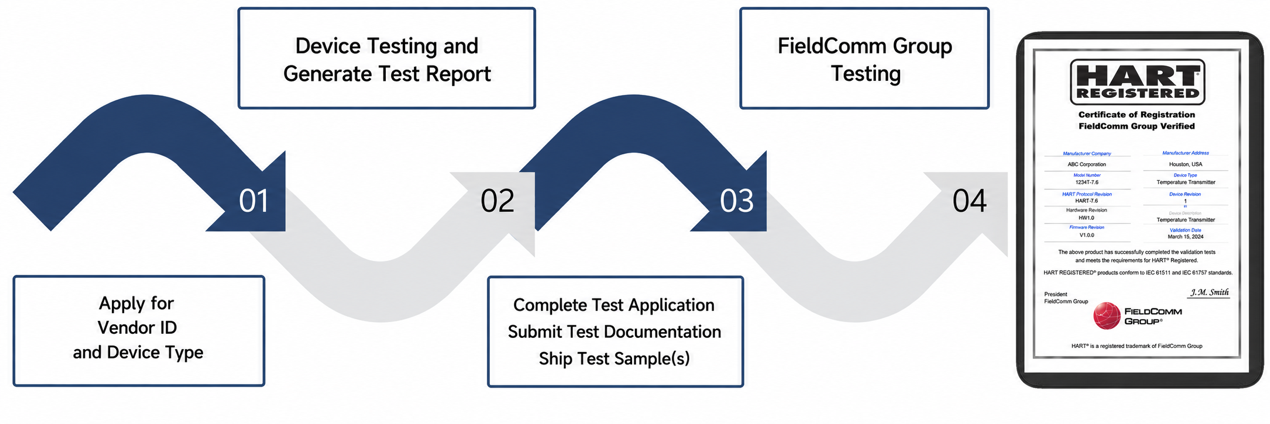
Step 1: Enterprise Qualification Access. Applying enterprises must first register as an FieldComm Group member to obtain official certification permissions, the latest agreement specifications, and test kits. Non-member enterprises cannot submit certification applications and can only access public basic information.
Step 2: Initial Product Self-Testing and Correction. The company shall conduct internal product self-testing in accordance with the HART testing specifications issued by FieldComm Group (including standards such as HCF_TEST-4 and TT20004), focusing on identifying issues related to protocol stack compliance, signal stability, and instruction compatibility. Bugs should be corrected proactively to mitigate risks of failure during formal testing, while also compiling a complete set of documentation including self-test reports, product manuals, protocol stack source code, and FDI files.
Step 3: Online Application and Document Submission. The company creates a certification ticket on the FieldComm Group official platform, submits required documents—including purchase orders, corporate qualifications, product technical specifications, self-test records, FDI source code, and device hardware/software version information—and initiates the certification application.
Step 4: Preliminary Document Review. The FieldComm Group official review team conducts a compliance check on submitted documents, focusing on verifying document completeness, protocol stack standardization, and FDI file compatibility. Non-compliant documents require supplementation or modification. Upon approval, the enterprise will be notified to submit test samples.
Step 5: Official testing by a third-party laboratory. The authorized laboratory shall establish a standardized testing environment and conduct comprehensive tests covering the physical layer, protocol stack, functional specifications, interoperability, etc., while documenting all test data to produce a standardized test report. If the test fails, the enterprise must rectify the issues and repeat the testing.
Step 6: Final Review and Certification Issuance. FieldComm Group reviews the laboratory test reports, confirms compliance with all requirements, completes official product registration, issues the HART certification certificate, authorizes the enterprise to use the official HART certification mark, and registers the product in the global HART certified device directory for public access and verification across the network.
2 Key Test Items for HART Certification
The HART certification test comprises four core modules: hardware physical specifications, protocol stack compliance, functional requirements, and interoperability. All items must meet all criteria 100% to pass certification.
First, physical layer performance testing. The core tests include evaluating the frequency accuracy, waveform integrity, signal amplitude, and loop impedance compatibility of FSK (Frequency Shift Keying) signals; verifying that the device exhibits no signal interference, waveform distortion, or frequency deviation in standard 4–20 mA circuits; assessing bus terminal matching, branch length suitability, and load compatibility; and identifying potential issues such as signal reflection or echo interference.
Second, protocol stack consistency testing. verifies that the device's protocol stack fully complies with the latest HART protocol specifications, including standardized data frame formats, address definitions, transmission timing, and error-check mechanisms, eliminating violations such as protocol truncation or custom private fields to ensure consistent fundamental communication.
Third, general commands and specialized function testing. In accordance with the HART General Command Specification, test the device's basic functions—including parameter reading/writing, range calibration, unit switching, device information retrieval, fault diagnosis, and zero-point verification—as well as the compliance of its dedicated extended functions, ensuring precise command responses without errors or data anomalies.
Fourth, interoperability and stability testing. Conduct interoperability tests with mainstream HART host computers, gateways, and control systems to verify the stability of cross-brand device networking, data interaction, and remote configuration. Additionally, perform prolonged continuous communication tests to identify issues such as disconnections, packet loss, and latency.
3 Common Issues in HART Certification
Based on practical industry certification experience, HART device certification failures primarily stem from four common issues, which also represent key areas for corporate R&D and improvement efforts.
First, physical layer signal parameters exceed specifications. Issues include frequency deviation, waveform distortion, and insufficient signal amplitude in FSK signals; poor circuit load compatibility; signal attenuation and data packet loss under heavy-load conditions, which are primarily attributed to non-standard hardware circuit design or improper selection of modulation modules.
Second, the protocol stack customization is non-standard. Some enterprises, in an effort to streamline R&D and reduce costs, arbitrarily modify standard protocol specifications and alter data frame formats, resulting in devices that can only communicate individually but lack compatibility with mainstream systems and gateways, leading to failed interoperability testing.
Third, incompatibility of FDI/DD documents. Common issues during the documentation review phase include non-standard device description files, missing parameter definitions, and incorrect function mappings, which prevent the host computer from properly identifying devices, reading parameters, or issuing configuration commands.
Fourth, the operational stability is insufficient. During prolonged network testing, issues such as device disconnections, reboots, and command response timeouts have occurred, coupled with poor resistance to electromagnetic interference, resulting in substandard communication stability under complex industrial conditions.